
Wait… You’re Telling Me It’s Not A PD Problem?
“Professional development that doesn’t change teaching practice is a waste of time and resources.” - Thomas R. Guskey
School improvement plans fail for a multitude of reasons, but as we shared in our most recent post, When Improvement Plans Stall, many of these failures can be traced to a deeper issue. That issue is simple: teams are trying to lead change without the knowledge to do it well.
We named four areas of expertise required to plan effective change:
Conceptual Understanding
Contextual Awareness
Systems Thinking
Change Leadership
When leadership teams build these areas into their planning process, the result is a clearer, more coherent improvement plan. But even the best plan won’t matter if it doesn’t lead to one thing: a change in teaching practice.
That’s the real purpose of any school improvement effort - and that means teacher professional development isn’t just part of the plan. It is the plan.
The Problem Isn’t That We Don’t Offer PD - It’s That It Doesn’t Work
The research is clear: the classroom teacher is the most important school-based factor in student learning. So it stands to reason that any plan to improve student outcomes must center on changing what happens inside classrooms.
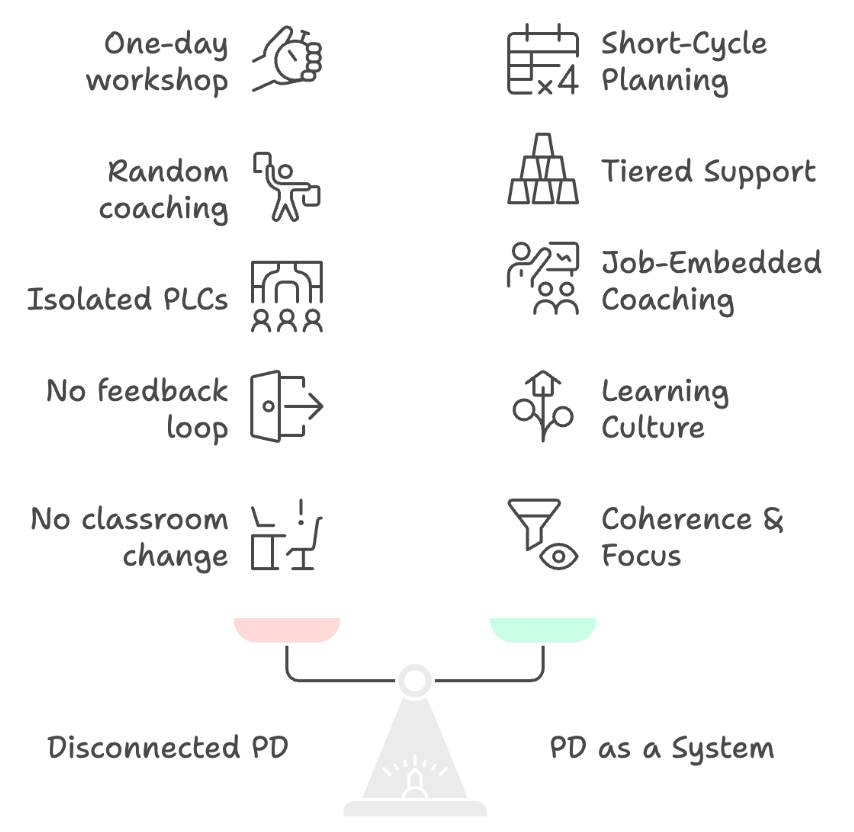
But here’s where things break down: we offer PD, we run coaching cycles, we organize PLCs. And yet, too often, teaching doesn’t actually change. There are no significant gains in achievement to demonstrate those efforts have made a difference.
Why?
Because what we offer isn’t a system - it’s a disconnected set of events. And those doesn’t work.
So What Does Work? A Professional Development System
When professional development works, it’s because the school has created a system - a set of integrated components that work together to achieve a specific outcome. Systems generate real changes in teaching that improve student learning, unlike the hodge-podge of PD programs that are often thrown together after a one-day leadership retreat. .
We've written about this in several previous posts, but let’s bring it all together here.
An effective PD system includes five core components:
1. Coherence and Focus
(See: “Overwhelmed Teachers Don’t Grow”)
Before we talk about learning strategies, we need to talk about cognitive load. Teachers can’t improve if they’re buried under a dozen competing initiatives. An effective PD system starts by creating coherence - intentionally limiting, aligning, and sequencing change efforts so teachers can actually succeed without too many competing responsibilities.
2. Sustained, Tiered Support
(See: “PD is Not an Event” and “Adult MTSS”)
PD must go beyond the “sit-and-get.” It requires a full system of support - think whole-group training (Tier 1), embedded collaboration (Tier 2), and individualized coaching (Tier 3). Just like students, teachers need different levels of support based on their readiness and needs.
At Compass Edvantage, we call this an Adult MTSS - a framework that mirrors our best thinking about student learning, applied to adult growth.
✅ 3. Short-Cycle Planning and Feedback Loops
(See: “Adult MTSS” and “Don’t Do PLCs… Unless”)
Annual plans are too slow and too vague. The most effective professional learning happens in short cycles - 90 days or less - with clearly defined instructional outcomes and ongoing data collection and analysis to track progress. Individual teacher coaching should be even quicker - 2-4 weeks. We all need to see impact quickly to stay motivated and grow collective efficacy.
✅ 4. Job-Embedded Collaboration and Coaching
(See: “The Power of Beliefs”)
Professional learning doesn’t end when the workshop does. Ongoing collaboration and coaching are essential - but only when they’re part of a larger system, not just reactive supports. Coaching cycles should be tightly aligned with your improvement plan and use real-time data to drive reflection and growth.
✅ 5. A Culture That Supports Adult Learning
PD systems don’t live in isolation - they exist inside school cultures. That culture needs to value reflection, support risk-taking, and offer time and space for real professional learning that teachers feel safe to engage in. Leaders must model the learning they want to see and create an environment where growth is the norm.
From Vision to Reality: Embedding the PD System in the School Improvement Plan
These five components aren’t “extra.” They are the professional learning plan. And the professional learning plan is the improvement plan.
Here’s the good news: if you already use short-cycle improvement planning, it’s the perfect structure for embedding this system. Your 90-day plans should include:
A clearly defined instructional focus
A tiered support plan for teacher development
Aligned coaching and collaboration structures
Measures of progress at the teacher and student level
Clear communication procedures to show staff how quickly they are making gains towards school-wide goals
When you do this, your PD isn’t a one-off event. It’s the engine of school improvement.
What’s Next: Leadership Moves That Make the System Work
Of course, building this system takes more than a good framework - it takes leadership.
In our next post, we’ll look at the specific moves leaders need to make to bring this vision to life. You’ll learn:
The hidden leadership skill behind every successful PD system
How to avoid the most common traps in PD planning
Why trying to “go slow to go fast” might be your biggest mistake
Reflection
What’s one component from the PD system above that your school is already doing well - and what’s one area that could be stronger?


Comments